
Private Investigator Surveillance in South Africa: What Is Legal and What Is Not
Surveillance is one of the most misunderstood aspects of private investigations. Television and movies have created the impression that private investigators operate outside the law — hacking phones, planting illegal tracking devices, intercepting WhatsApp messages, and spying through windows. ‘’James Bond 007’’.
The reality is very different.
Professional surveillance in South Africa is a lawful, disciplined, and highly strategic investigative process focused on gathering factual evidence while remaining within the boundaries of the law. A professional private investigator understands that evidence is only valuable if it is collected legally and can withstand scrutiny in court.
In today’s environment, surveillance investigations are becoming increasingly important due to rising fraud, corruption, cybercrime, insurance scams, employee misconduct, domestic disputes, and restraint of trade violations.
At PI INVESTIGATOR, surveillance operations are conducted using legally compliant methodologies designed to protect both the client and the integrity of the evidence. Our private investigators operate in Johannesburg, Pretoria, Cape Town, and throughout South Africa.
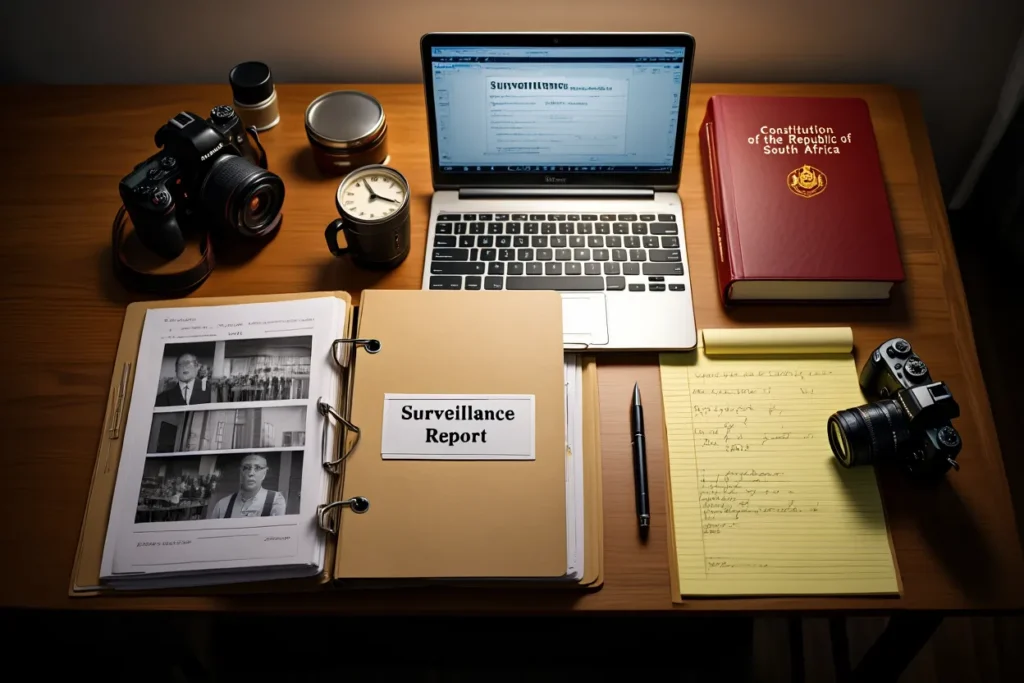
What Is Surveillance in Private Investigations?
Surveillance refers to the discreet observation of a person, business, vehicle, property, or activity for the purpose of gathering factual information and evidence.
Contrary to popular belief, professional surveillance is not about harassment or intimidation. It is about documenting behaviour objectively and lawfully.
A surveillance operation may involve:
- Monitoring movements and activities
- Verifying workplace misconduct
- Observing meetings and associations
- Investigating cheating spouses
- Identifying fraudulent insurance claims
- Confirming restraint of trade violations
- Tracking organised theft syndicates
- Documenting behavioural patterns
- Recording time-stamped evidence
- Conducting static and mobile surveillance
- Divorce matters
- Child custody disputes
- Fraud investigations
- Corporate investigations
- Insurance investigations
- Labour disputes
- Asset tracing matters
- Criminal defence preparation
- Workplace misconduct investigations
Why Surveillance Has Become Increasingly Important in South Africa
South Africa continues to face serious challenges involving fraud, corruption, organised crime, and financial misconduct.
According to the Association of Certified Fraud Examiners (ACFE), organisations globally lose an estimated 5% of annual revenue to occupational fraud each year.
The South African banking and financial sector has also repeatedly warned about increases in digital fraud, impersonation scams, and business email compromise attacks. SABRIC regularly publishes alerts relating to cyber-enabled fraud and social engineering scams affecting South African businesses and individuals.
As a result, many companies, attorneys, insurers, and private individuals are turning to professional private investigators to gather evidence quickly and discreetly.

The Constitution of South Africa
A lawful surveillance operation must comply with South African legislation and constitutional rights.
This is where experienced investigators separate themselves from inexperienced operators.
A major misconception in South Africa is that “any evidence is good evidence.”
That is not true.
Irrespective of what a person may be guilty of, constitutional rights still apply. South African law places strong emphasis on privacy rights, lawful investigative conduct, and evidential fairness.
Investigators must work within legislation such as:
- Trespass unlawfully
- Intercept communications illegally
- Hack devices
- Access emails unlawfully
- Plant listening devices illegally
Even individuals suspected of criminal conduct retain constitutional protections.
Improper surveillance methods can expose both the investigator and the client to criminal liability and civil litigation.

RICA – Regulation of Interception of Communications Act
The RICA Act strictly regulates the interception of communications in South Africa.
A lawful private investigator cannot:
- Hack WhatsApp accounts
- Clone cellphones
- Intercept calls
- Conduct unlawful live cellphone tracking
- Access social media accounts illegally
- Install illegal surveillance software
Many online advertisements claiming investigators can “hack phones” are either fraudulent or involve unlawful conduct.
At PI INVESTIGATOR, we strongly believe that evidence gathered unlawfully can destroy an otherwise legitimate case.
POPIA – Protection of Personal Information Act
The Information Regulator South Africa oversees compliance with POPIA.
Professional investigators handling sensitive information must:
- Secure evidence properly
- Protect client confidentiality
- Prevent unlawful disclosure
- Maintain evidence integrity
- Preserve chain of custody
- Process information lawfully
Failure to protect evidence properly can severely compromise litigation or criminal proceedings.
PSIRA Registration Matters
A legitimate private investigator MUST be registered with the Private Security Industry Regulatory Authority (PSIRA).
Unregistered operators may expose clients to:
- Illegal surveillance methods
- Inadmissible evidence
- Fraudulent practices
- Civil liability
- Criminal prosecution
Before hiring any investigator, clients should verify that the investigator operates lawfully and professionally. This duty falls squarely on the client.
Why Professional Surveillance Requires Extensive Training
Many people assume surveillance simply involves following somebody around.
In reality, professional surveillance is one of the most technically demanding investigative disciplines.
Experienced surveillance investigators are trained in:
- Counter-surveillance awareness
- Mobile surveillance operations
- Static surveillance positioning
- Behavioural analysis
- Route prediction
- Vehicle rotation techniques
- Operational planning
- Risk mitigation
- Evidence logging
- Photography and videography
- Situational awareness
Professional surveillance requires patience, discipline, and operational awareness.
An investigator who lacks experience may compromise an entire operation within minutes.
The Art of Remaining Undetected
One of the greatest failures in amateur surveillance operations is becoming “burned” or identified by the target.
- The operation may collapse
- Evidence gathering may stop
- Behaviour may change
- Safety risks may escalate
Professional investigators understand that surveillance is psychological.
Targets often detect inexperienced investigators because they:
- Follow too closely
- Use the same vehicle repeatedly
- Park suspiciously
- Behave unnaturally
- Maintain prolonged visual contact
- Remain stationary too long
- Vehicle rotation
- Layered surveillance teams
- Timed movement
- Observation points
- Urban blending
- Environmental cover
- Behavioural prediction
Surveillance in Cheating Spouse Investigations
Infidelity investigations remain one of the most requested private investigation services globally.
Modern technology has changed how affairs are conducted and concealed. Encrypted messaging applications, secret social media accounts, and dating platforms have created new opportunities for deception.
Professional surveillance may assist in:
- Confirming or disproving suspicions
- Identifying meeting locations
- Establishing behavioural patterns
- Gathering factual evidence
- Protecting clients from false assumptions
Importantly, professional investigators focus on facts — not emotion.
At PI INVESTIGATOR, surveillance often reveals outcomes clients did not expect. In some matters, suspicions are confirmed. In others, innocent spouses are completely cleared.
Objectivity is critical.
Workplace Surveillance and Employee Misconduct Investigations
South African businesses are increasingly using surveillance investigations to address internal threats and misconduct.
Workplace investigations may involve:
- Theft investigations
- Time fraud
- Moonlighting investigations
- Fraudulent sick leave claims
- Workplace collusion
- Asset misappropriation
- Unauthorised competing businesses
- Misuse of company resources
Surveillance investigations often work alongside:
- Digital forensic investigations
- Access control analysis
- Social media investigations
- Background checks
- Corporate intelligence gathering
Restraint of Trade Surveillance Investigations

Restraint of trade breaches can severely damage a company’s client base, confidential information, and competitive position.
Surveillance investigations may assist by:
- Confirming employment with competitors
- Documenting competing business activity
- Identifying client solicitation
- Monitoring intellectual property misuse
- Verifying contractual breaches
These investigations are highly sensitive because improperly obtained evidence can damage the client’s legal position entirely.
This is why lawful surveillance practices are essential.
Insurance Fraud Surveillance Investigations

Insurance fraud continues to cost insurers billions globally every year.
Professional surveillance investigations may involve:
- Disability fraud investigations
- False injury claims
- Vehicle fraud
- Workers compensation fraud
- Staged accident investigations
Investigators may monitor whether claimants engage in activities inconsistent with their alleged injuries or claims.
However, lawful surveillance must always remain within public and legal boundaries.

Why Illegal Surveillance Can Destroy a Case
One of the biggest misconceptions is that “evidence is evidence.” Ensure what is obtained are sound, court-ready evidence and not illegally obtained.
This is false.
Evidence obtained unlawfully may:
- Be excluded from court
- Damage litigation
- Lead to criminal charges
- Create civil liability
- Destroy credibility
Examples include:
- Illegal recordings
- Trespassing
- Device hacking
- Unlawful GPS tracking
- Illegal interception of communications
Chain of custody is equally important.
Evidence must clearly demonstrate:
- When it was collected
- Who collected it
- How it was stored
- Whether it was altered
- Whether continuity was maintained
Even strong evidence may become unusable if evidence handling procedures are flawed.

The Psychology Behind Professional Surveillance
Professional surveillance requires extreme patience and emotional discipline.
Investigators may spend:
- 12–16 hours monitoring one target
- Days observing limited activity
- Weeks developing behavioural patterns
A professional investigator avoids:
- Emotional involvement
- Assumptions
- Confirmation bias
- Speculation
The objective is simple:
Document facts objectively and lawfully.
This is what separates professional surveillance investigators from amateurs.
Why Experience Matters in Surveillance Investigations
Surveillance is one of the easiest investigative disciplines to perform poorly.
An inexperienced investigator may:
- Miss critical evidence
- Become detected
- Compromise the operation
- Escalate unnecessary risks
- Gather unusable evidence
An experienced investigator understands:
- Human behaviour
- Operational timing
- Legal limitations
- Risk management
- Court requirements
- Evidence preservation
In many investigations, experience determines whether a case succeeds or fails.

Why PI INVESTIGATOR Is Trusted for Surveillance Operations
PI INVESTIGATOR has established itself as a professional investigative agency offering surveillance investigations across South Africa.
Our capabilities are strengthened by:
- Experienced investigators
- Former law enforcement expertise
- Criminology knowledge
- Court-ready reporting
- Legally compliant methodologies
- National operational capability
- Advanced surveillance planning
We conduct surveillance operations in:
- Johannesburg
- Pretoria
- Cape Town
FAQ
Can a private investigator legally follow someone in South Africa?
Yes. A private investigator may conduct lawful surveillance in public spaces provided no laws are violated and constitutional rights are respected.
Can a private investigator hack WhatsApp messages?
No. Intercepting private communications unlawfully may violate RICA and other South African laws.
Can a private investigator hack WhatsApp messages?
Potentially yes, provided the evidence was gathered lawfully and proper chain-of-custody procedures were followed.
Can surveillance investigations help in divorce cases?
Yes. Surveillance investigations may assist in confirming behavioural patterns, identifying misconduct, or disproving suspicions.
How long does a surveillance investigation usually take?
The duration depends on the complexity of the matter, the behaviour of the target, and the investigation objectives.
Are GPS tracking devices legal in South Africa?
This depends on ownership, consent, and legal context. Unlawful tracking may expose individuals to legal consequences.
What happens if a surveillance investigator gets caught?
A compromised operation may result in evidence loss, operational failure, or increased safety risks.
Why should I hire a professional surveillance investigator instead of doing it myself?
Professional investigators understand legal boundaries, evidence preservation, operational planning, and risk mitigation. Improper surveillance can destroy a case entirely.
Can surveillance investigations uncover workplace fraud?
Yes. Surveillance is commonly used to investigate employee misconduct, theft, moonlighting, and fraudulent activity.
Does PI INVESTIGATOR operate nationally?
Yes. PI INVESTIGATOR conducts investigations in Johannesburg, Pretoria, Cape Town, and throughout South Africa.
Final Thoughts
Professional surveillance is not about Hollywood-style spying or unlawful conduct. It is a structured investigative discipline grounded in legality, patience, operational awareness, and evidentiary integrity.
In South Africa’s increasingly complex criminal and commercial environment, surveillance investigations have become an essential tool for businesses, insurers, attorneys, and private individuals seeking lawful and factual evidence.
The difference between professional surveillance and amateur conduct can determine whether evidence strengthens a case — or destroys it completely.
For this reason, choosing an experienced and legally compliant investigative firm matters enormously.