
Can Private Investigators Make Arrests in South Africa?
The Short Answer: No – But There Is an Important Exception
One of the biggest misconceptions about private investigators is that they possess the same powers as police officers. Television shows and Hollywood movies often portray private detectives chasing suspects, forcing entry into buildings, displaying badges and placing suspects under arrest. Private investigators does however carry an appointment card for identification, however, their powers are limited in the general course of their duties.
The reality in South Africa is very different.
A licensed private investigator is not a peace officer and does not possess police powers. A private investigator cannot simply arrest someone because they have uncovered evidence of fraud, theft or another criminal offence.
However, South African law provides an important exception.
Like every other citizen, a private investigator may perform a citizen’s arrest under very limited circumstances in terms of Section 42 of the Criminal Procedure Act 51 of 1977. This right belongs to every citizen—not because they are a private investigator—but because the law grants limited arrest powers to members of the public in specific situations.
Understanding this distinction is essential.


What Is a Private Investigator?
Before discussing arrests, it is important to understand what a private investigator actually does.
A professional private investigator is employed to gather lawful evidence on behalf of clients. Their work may include:
- Fraud investigations
- Corporate investigations
- Surveillance
- Cyber crime investigations
- Background screening
- Asset tracing
- Cheating spouse investigations
- Sextortion Investigations
- Due diligence
- Insurance fraud investigations
- Litigation support
Unlike SAPS detectives, private investigators work on behalf of private clients, attorneys, corporations and insurers. We as private investigators do however possess very unique skills and expertise and in many cases more experienced as SAPS. Many of those who end up in the private industry are all ex police officers, intelligence officers or even ex prosecutors.
The Private Security Industry Regulation Act (PSIRA) defines and regulates private investigators in South Africa, requiring registration and adherence to professional standards.


Private Investigators Are Not Police Officers
This distinction cannot be overstated.
A private investigator cannot:
- Obtain search warrants
- Obtain arrest warrants
- Execute search warrants
- Force entry into premises
- Intercept telephone calls
- Read private messages
- Hack social media accounts
- Access bank records without lawful authority
- Compel witnesses to provide statements
- Charge suspects with criminal offences
Only authorised law enforcement agencies possess these powers. We do however have a role to play and presenting evidence that could be used in motivation for the above.
Instead, the role of the investigator is to lawfully obtain evidence and present it to:
- SAPS
- Hawks (DPCI)
- Prosecutors
- Attorneys
- Civil Courts
- Criminal Courts
- Tribunals
This is precisely why professionally gathered evidence often becomes the foundation of successful criminal prosecutions.
For a detailed explanation, see our guide on Private Investigators and Court-Ready Evidence in South Africa.


What Does Section 42 of the Criminal Procedure Act Say?
Section 42 permits any private person to arrest another person without a warrant in specific circumstances.
Examples include:
A person commits a Schedule 1 offence in your presence
Examples include:
- Murder
- Rape
- Housebreaking
- Robbery
- Theft
- Fraud (depending on circumstances)
- Arson
- Kidnapping
If the offence occurs in your presence, a citizen may lawfully arrest the suspect.
Reasonable suspicion of a Schedule 1 offence
The law also allows arrest where a person reasonably suspects someone committed a Schedule 1 offence.
The key phrase is reasonable suspicion.
This does not mean:
“I think he looks suspicious.”
It means there must be objective facts supporting the belief.
Courts have repeatedly held that an arrest without reasonable grounds may constitute wrongful arrest and expose the arresting party to civil liability. We as South Africans have a constitutional right to freedom of movement, if someone is placed under arrest his or her right to movement is restricted therefore, you are taking away a very fundamental right enshrined in section 21 of the Bill of Rights.
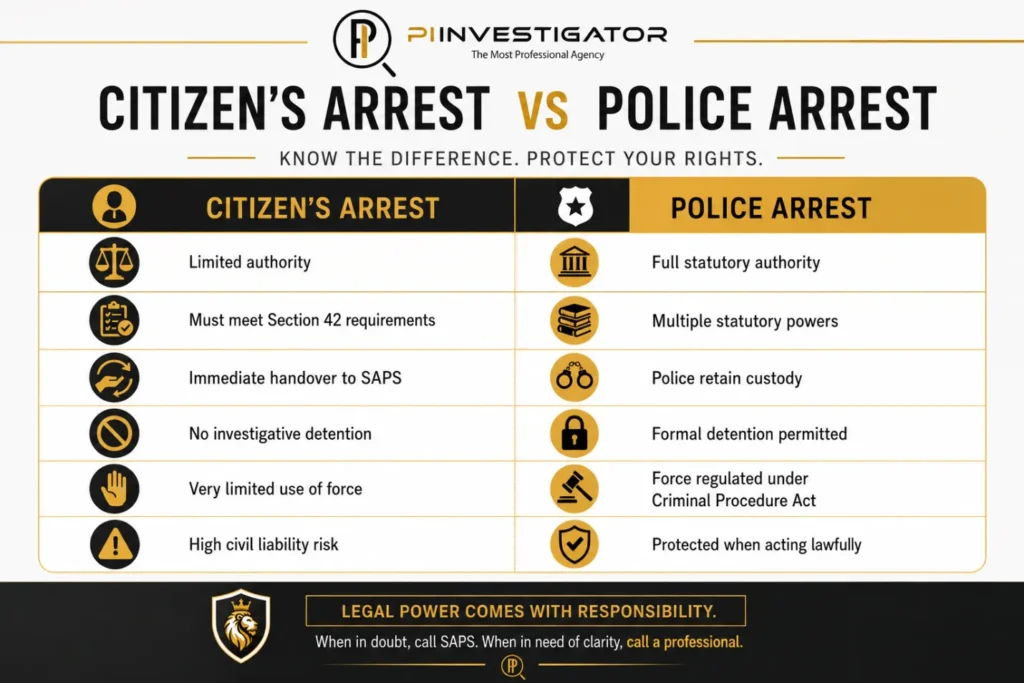
Citizen's Arrest vs Police Arrest
Many people incorrectly believe these are identical.
They are not.
This distinction is extremely important for professional investigators.

What Does Section 42 of the Criminal Procedure Act Say?
Section 42 permits any private person to arrest another person without a warrant in specific circumstances.
Examples include:
A person commits a Schedule 1 offence in your presence
Examples include:
- Murder
- Rape
- Housebreaking
- Robbery
- Theft
- Fraud (depending on circumstances)
- Arson
- Kidnapping
If the offence occurs in your presence, a citizen may lawfully arrest the suspect.
Reasonable suspicion of a Schedule 1 offence
The law also allows arrest where a person reasonably suspects someone committed a Schedule 1 offence.
The key phrase is reasonable suspicion.
This does not mean:
“I think he looks suspicious.”
It means there must be objective facts supporting the belief.
Courts have repeatedly held that an arrest without reasonable grounds may constitute wrongful arrest and expose the arresting party to civil liability. We as South Africans have a constitutional right to freedom of movement, if someone is placed under arrest his or her right to movement is restricted therefore, you are taking away a very fundamental right enshrined in section 21 of the Bill of Rights.

When Might a Private Investigator Perform a Citizen's Arrest?
Although legally possible, it is actually quite rare.
Examples might include:
Theft observed during surveillance
An investigator conducting surveillance witnesses an employee stealing expensive equipment from a warehouse.
The theft occurs directly in front of the investigator. The reason why this rarely happens is because private investigators are in many instances undercover; this will certainly compromise their cover and deem any future operations futile.
How this be the case, Section 42 may apply.


Why Experienced Investigators Rarely Make Arrests
This surprises many clients.
The reality is that experienced investigators generally prefer not to arrest suspects unless absolutely necessary.
Why?
Because arrests create unnecessary legal risk.
Instead, professional investigators focus on:
- Identifying suspects
- Gathering admissible evidence
- Recording surveillance
- Preserving CCTV footage
- Obtaining witness statements
- Protecting the chain of custody
- Assisting SAPS
In most investigations, this approach produces far stronger cases than dramatic confrontations.
At PI INVESTIGATOR, our philosophy has always been simple:
Evidence first. Arrest second.
The objective is never simply to detain someone—it is to ensure that the evidence withstands scrutiny in court. Nothing could be more devastating to see your actions led to an acquittal, the objective must always be to present the evidence and ensure the suspect is brought to book.

Why Illegal Arrests Can Be Extremely Expensive
An unlawful arrest can expose both an investigator and their client to civil claims.
Potential consequences include:
- Wrongful arrest lawsuits
- Assault claims
- Defamation claims
- Damages for unlawful detention
- PSIRA disciplinary proceedings
- Criminal charges
This is precisely why experienced investigators receive continuous legal training regarding:
- Constitutional rights
- Criminal Procedure Act
- POPIA
- RICA
- Law of evidence
- Chain of custody
Professional investigators understand where their authority begins—and where it ends.
Movies vs Reality
Hollywood has created many myths.
Movies show investigators:
❌ Kicking down doors
❌ Handcuffing suspects
❌ Conducting interrogations
❌ Carrying police badges
❌ Searching homes
None of these accurately reflects the role of a private investigator in South Africa.
The best investigators spend far more time:
- Planning operations
- Conducting surveillance
- Analysing evidence
- Interviewing witnesses
- Preparing reports
- Consulting attorneys
- Supporting prosecutions
The excitement comes from uncovering the truth—not pretending to be law enforcement.

How PI INVESTIGATOR Works With SAPS
One of the reasons clients choose PI INVESTIGATOR is our understanding that successful investigations often require cooperation rather than competition.
We regularly assist by:
- Preparing comprehensive evidence files
- Registering criminal complaints on behalf of authorised clients where appropriate
- Liaising with investigating officers
- Assisting prosecutors
- Locating witnesses
- Recovering CCTV footage
- Preparing affidavits
- Identifying additional suspects
- Providing court-ready investigation reports
Rather than replacing SAPS, we complement criminal investigations by delivering professionally gathered evidence that saves valuable investigative time.
This collaborative approach often produces significantly better outcomes for clients.
Experience Matters More Than Powers
Many people assume an investigator’s effectiveness depends upon having arrest powers.
The opposite is often true.
The best investigators solve cases because they understand:
- Human behaviour
- Surveillance techniques
- Interview methodology
- Digital investigations
- Financial analysis
- Evidence preservation
- Criminal procedure
- Civil litigation
These skills consistently deliver results—without unnecessary confrontation.
This is why businesses, law firms, insurers and private individuals across South Africa trust PI INVESTIGATOR with sensitive investigations.
Whether you require a Private Investigator, a Private Investigator in Johannesburg, a Private Investigator in Cape Town, or assistance anywhere in South Africa, our team focuses on legally obtaining evidence that stands up in court.
Why Clients Choose PI INVESTIGATOR
At PI INVESTIGATOR, we believe professionalism is measured not by dramatic arrests, but by successful outcomes.
Our investigators are known for:
- Lawful investigative methods
- Complete confidentiality
- Court-ready evidence
- Detailed reporting
- Corporate investigation expertise
- Fraud investigation specialists
- Advanced surveillance capabilities
- Nationwide investigations
- Ethical conduct
- Professional liaison with SAPS and legal practitioners
Ultimately, the strongest case is not built on making an arrest. It is built on presenting credible, admissible and compelling evidence.
Here is a comprehensive blog discussing the difference between SAPS VS PI’S, one could clearly see the distinct difference and understand we both have a role to play in society.
Frequently Asked Questions (FAQs)
1. Can a private investigator arrest someone in South Africa?
No. Private investigators do not have police powers and cannot arrest people simply because they are investigators. However, like any member of the public, they may perform a citizen’s arrest under very limited circumstances in terms of Section 42 of the Criminal Procedure Act 51 of 1977, provided the legal requirements are met.
2. Can a private investigator detain a suspect until the police arrive?
Only in very limited circumstances where a lawful citizen’s arrest has been made. Any detention must be reasonable, lawful, and the suspect must be handed over to the South African Police Service (SAPS) as soon as reasonably possible. Unlawful detention may expose the investigator to civil and criminal liability.
3. Do private investigators have the same powers as the police?
No. Private investigators cannot execute search warrants, issue subpoenas, force entry into premises, intercept communications, or compel individuals to provide information. Their role is to lawfully gather evidence and provide factual findings to clients, attorneys, insurers, or law enforcement agencies.
4. What should I do if a private investigator uncovers evidence of a crime?
If a private investigator discovers evidence of criminal conduct, they will typically compile a comprehensive investigation report, preserve the evidence, and assist the client in reporting the matter to SAPS. In many cases, investigators also liaise with investigating officers and prosecutors to support the criminal investigation.
5. Can a private investigator investigate fraud and theft?
Yes. Fraud and theft investigations are among the most common services provided by professional private investigators. These investigations may include surveillance, forensic document examination, witness interviews, financial analysis, asset tracing, and evidence gathering to support civil or criminal proceedings.
6. Is it legal to hire a private investigator in South Africa?
Yes. Hiring a private investigator is completely legal, provided the investigator operates within South African law and is registered with the Private Security Industry Regulatory Authority (PSIRA) where required. A reputable investigator will always conduct investigations lawfully while respecting constitutional rights and privacy legislation.
7. Can evidence gathered by a private investigator be used in court?
Yes. Evidence obtained legally by a professional private investigator can often be used in both civil and criminal proceedings. Proper evidence handling, documentation, chain of custody, and lawful investigative methods are essential to ensure the evidence is admissible and credible in court.
8. When should I hire a private investigator instead of reporting directly to SAPS?
You should consider hiring a private investigator when you require an independent investigation, need to gather evidence before opening a criminal case, suspect fraud within a business, require surveillance, need to locate assets or missing persons, or require assistance with litigation. Private investigators often complement SAPS investigations by providing professionally gathered evidence.
9. How do I know if a private investigator is reputable?
Choose an investigator with extensive experience, a proven track record, professional references, transparent pricing, and knowledge of South African law. Reputable investigators should operate ethically, maintain confidentiality, provide written reports, and avoid making unrealistic promises such as guaranteeing arrests or convictions.
10. Why should I choose PI INVESTIGATOR?
PI INVESTIGATOR is one of South Africa’s leading private investigation firms, trusted by private individuals, businesses, attorneys, and insurers nationwide. Our experienced investigators specialise in fraud investigations, surveillance, asset tracing, background checks, litigation support, and corporate investigations. We focus on gathering lawful, court-ready evidence while maintaining the highest standards of professionalism, confidentiality, and integrity. Whether you require assistance in Johannesburg, Cape Town, or anywhere in South Africa, our team is committed to uncovering the truth and delivering results you can rely on.